
DIGITAL MARKETING: TURNING ATTENTION INTO MEANIMGFUL CONNECTIONS
Imagine waking up in the morning and checking your phone. Before breakfast, you might see an Instagram advertisement, watch a YouTube video, search for a product on Google, or receive an email from a brand. Without even realizing it, you have already interacted with digital marketing.
Digital marketing has become an important part of everyday life. It is no longer something used only by large companies with huge advertising budgets. Today, small businesses, startups, freelancers, influencers, and even individual creators use digital platforms to reach people and build their brands.
But digital marketing is not simply about advertising a product on the internet. At its core, it is about understanding people, gaining their attention, providing value, and building lasting relationships.
WHAT MAKES DIGITAL MARKETING DIFFERENT
Traditional marketing mainly depends on channels such as newspapers, television, radio, magazines, billboards, and printed advertisements. Digital marketing uses internet-based platforms to communicate with audiences.
The biggest difference is interaction.
When someone sees a newspaper advertisement, the communication is mostly one way. In the digital world, customers can immediately like, comment, share, review, question, compare, or purchase a product.
For example, a person interested in buying a pair of shoes might discover a brand through Instagram. They may then visit the company’s website, read customer reviews, watch a product video on YouTube, compare prices, and finally place an order online.
This entire journey can happen without the customer ever visiting a physical store.
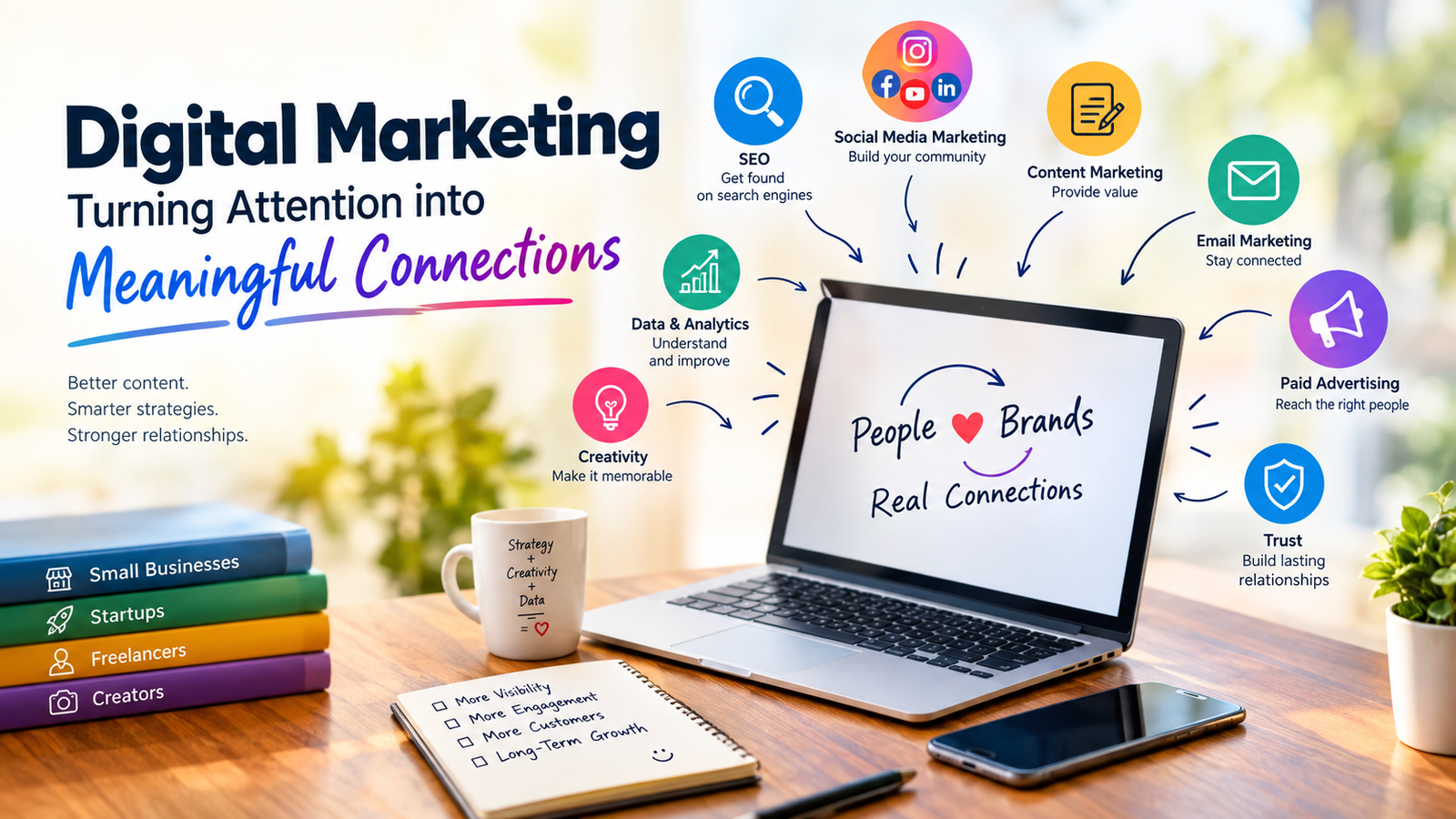
THE MAJOR ELEMENTS OF DIGITAL MARKETING
Digital marketing includes several different strategies, and each one plays a specific role.
1. Search engine optimization
Search Engine Optimization, commonly known as SEO, helps websites become more visible on search engines such as Google.
When people search for something online, they usually look at the first few results. SEO helps businesses improve their chances of appearing in those results.
This involves using relevant keywords, creating helpful content, improving website speed, making websites mobile-friendly, and building online credibility.
Good SEO is not simply about attracting visitors. It is about attracting the right visitors.
2. Social media marketing
media has transformed the relationship between brands and customers.
Platforms such as Instagram, Facebook, YouTube, LinkedIn, and other social networks allow businessSocial es to communicate directly with their audiences.
A brand can share educational posts, behind-the-scenes content, customer stories, product demonstrations, short videos, and creative campaigns.
The most successful social media presence does not always feel like advertising. Instead, it gives people a reason to follow, interact with, and remember the brand.
3. Content Marketing
Content is one of the strongest foundations of digital marketing.
People are constantly searching for information. They want to know how something works, which product is suitable for them, how to solve a problem, or how to improve their lives.
Content marketing answers those needs through blogs, articles, videos, podcasts, infographics, guides, newsletters, and social media content.
For example, a skincare company could create content explaining how to build a basic skincare routine instead of simply saying, “Buy our product.”
When content provides genuine value, customers may begin to see the brand as a useful source of information rather than just another seller.
4. Email Marketing
Even with the growth of social media, email remains an important digital marketing channel.
Businesses can use email to send newsletters, product updates, special offers, educational information, event invitations, and personalized messages.
Unlike social media, where algorithms influence what people see, email gives businesses a direct communication channel with subscribers.
However, successful email marketing depends on relevance. People are more likely to engage with emails that are useful and personalized rather than messages that simply promote products repeatedly.
5. Paid Advertising
Digital advertising allows businesses to reach specific groups of people through search engines, websites, social media, and other platforms.
One of its major advantages is targeting. Businesses can create campaigns based on factors such as interests, location, online behavior, and other audience characteristics, depending on the platform.
Digital advertising can also provide measurable results. Marketers can examine impressions, clicks, conversions, and other performance indicators to understand how a campaign is performing.
The Power Of Data
One of the most interesting aspects of digital marketing is the role of data.
In the past, marketers often had limited information about how audiences responded to advertisements. Digital platforms provide much more measurable feedback.
A marketer can discover which content receives attention, which pages visitors explore, how many people complete a purchase, and where potential customers leave the buying process.
This creates an ongoing learning process:
Create → Publish → Measure → Learn → Improve
Instead of assuming what customers want, businesses can study their behavior and make informed adjustments.
Creativity Still Matters
Although data is important, digital marketing is not purely about numbers.
People connect with stories, emotions, ideas, humor, visuals, and experiences. A campaign may have excellent data behind it, but without an interesting message, it may struggle to capture attention.
This is where creativity becomes important.
A simple idea presented in an original way can sometimes attract more attention than a complicated advertisement. A memorable story can make a brand easier to recognize. A genuine customer experience can create more trust than a polished promotional message.
The best digital marketing often happens when creativity and data work together.
The Importance Of Trust
The internet gives customers access to more choices than ever before. At the same time, it has made people more careful about what they believe.
Customers can read reviews, compare brands, check prices, watch independent videos, and ask other people for opinions before making a decision.
Because of this, trust has become a valuable part of digital marketing.
Businesses can build trust by communicating honestly, providing accurate information, responding to customers, protecting customer data, and delivering on their promises.
A brand may attract someone with an advertisement, but trust is what can encourage that person to return.
Digital Marketing and Small Business
Digital marketing has also created opportunities for small businesses.
A local bakery, clothing store, photography service, home-based business, or freelancer can build an online presence without needing a large physical advertising budget.
A smartphone can be used to create videos. Social media can showcase products. A website can provide information. Search engines can help potential customers discover the business.
This means that digital marketing is not only about competing with bigger companies. It can also help small businesses tell their stories and reach audiences that were previously difficult to access.
The Future of Digital Marketing
Digital marketing continues to evolve rapidly. Artificial intelligence, automation, short-form videos, personalized experiences, conversational tools, and new forms of online content are changing how businesses communicate.
However, technology alone will not guarantee success.
The fundamental question will remain the same:
What does the audience need, and how can a brand provide meaningful value?
Businesses that understand their customers, adapt to changing technology, create useful content, and communicate consistently can develop stronger digital relationships.
Conclusion
Digital marketing is much more than placing advertisements on the internet. It is a combination of technology, creativity, communication, strategy, and customer understanding.
It allows a small idea to reach a large audience, gives businesses the ability to understand customer behavior, and creates opportunities for direct communication.
The digital world is constantly changing, but one principle remains timeless: people connect with brands when they feel understood and valued.
Therefore, the future of digital marketing is not simply about getting more clicks, followers, or views. It is about turning attention into meaningful conversations, conversations into trust, and trust into long-term relationships.
In a world where everyone is competing for attention, the brands that truly understand their audience may be the ones people choose to remember.